Split system air conditioner installation cost in Newcastle, 2026
Updated 9 October 2026 · 9 min read
hipages gives a national guide of $1,400 to $3,000 supplied and installed for a simple split system, or $600 to $1,000 for installation alone. A Newcastle quote depends on the unit, access and work included. Any NSW scheme discount must be confirmed by a participating installer.
What it costs
| Item | Typical cost (2026) |
|---|---|
| Split system, supply and install (simple) | $1,400 to $3,000 |
| Split system unit only | $600 to $2,500 |
| Installation, basic | $600 to $1,000 |
| Installation, larger or complex | $1,000 to $2,000 |
| Multi-split, total | $3,000 to $10,000 |
| Installer hourly rate | $80 to $110 |
National price ranges from hipages' January 2026 guides, checked 9 October. These are not measured Newcastle quotes. Confirm the installation scope and GST in your own written quote.
What pushes the price up
A long pipe run between the indoor and outdoor units, a second-storey or roof-mounted outdoor unit, a new circuit from the switchboard, and brick walls to core through.
Take off the NSW discount
The NSW Government gives indicative Energy Savings Scheme discounts of up to $550 for a new 6 kW system or up to $560 when replacing an old unit with a 6 kW split system. A participating installer must confirm eligibility and the actual amount before installation. You still contribute towards the appliance and work; see the NSW rebate.
What a standard installation includes
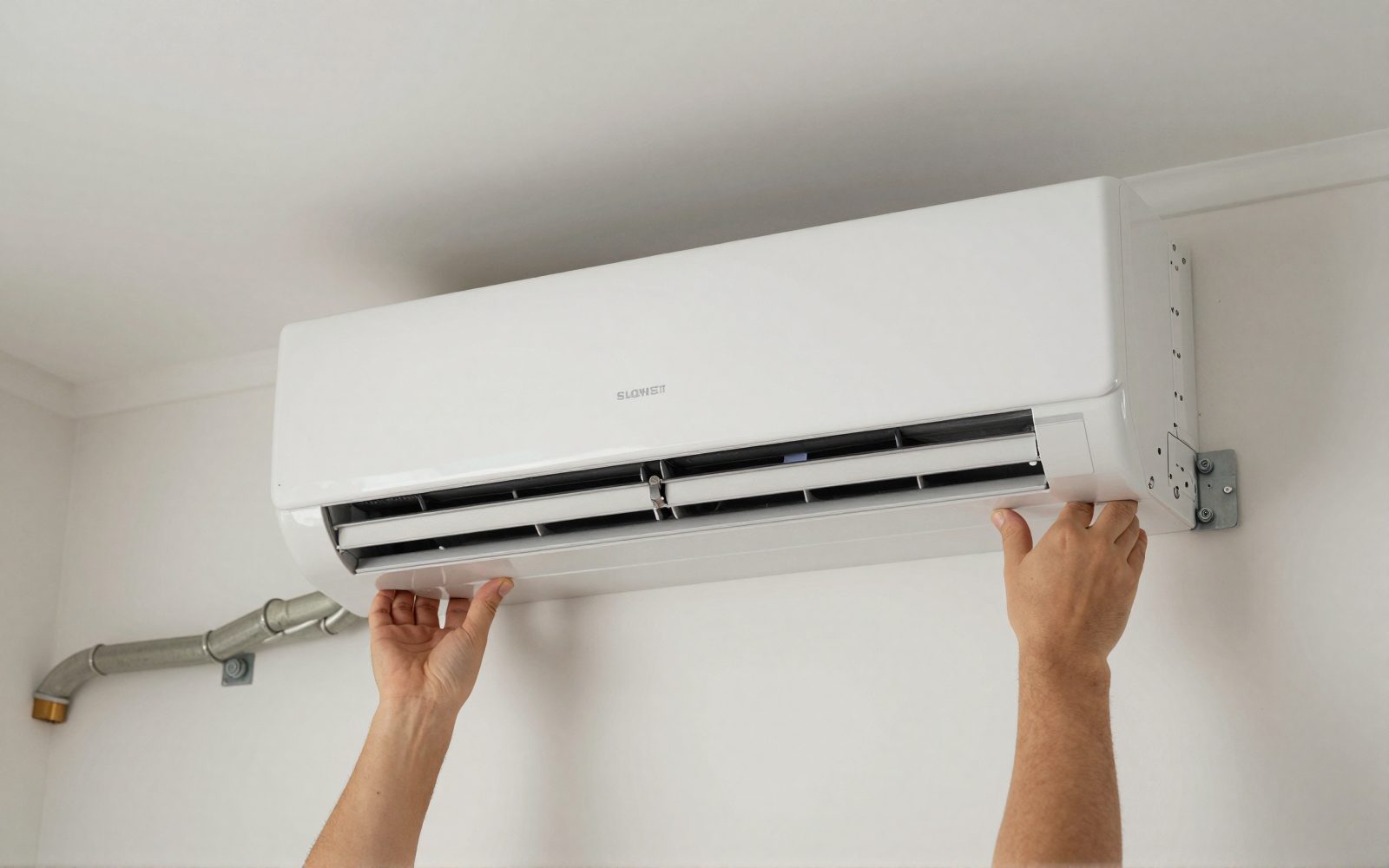
A "standard" or "back-to-back" installation is what most advertised prices assume. It usually means the indoor unit is mounted on an external wall, the outdoor unit sits directly behind it on the ground or a bracket at ground level, and the pipe run between them is short, often up to a few metres. It includes mounting both units, drilling one hole through the wall, running and connecting the refrigerant pipes, drain and control cable, vacuuming and commissioning the system, and connecting power to an existing suitable circuit. Anything beyond that is usually extra.
Extras that add to the quote
- A longer pipe run, when the indoor unit is on an internal wall or the outdoor unit must sit around a corner.
- A second-storey or roof-mounted outdoor unit, which needs brackets, extra labour and sometimes access equipment.
- A new electrical circuit from the switchboard, or a switchboard upgrade if there is no room for one.
- Coring through brick or concrete instead of a timber or fibro wall.
- Pipe covers or ducting to hide pipes on the outside wall neatly.
- A condensate pump when water cannot drain downhill from the indoor unit.
- Removing and disposing of an old unit, including recovering its refrigerant properly.
- Wall reinforcement for a large indoor unit on a weak wall.
Ask every installer to list these as separate lines so you can compare quotes fairly.
Choosing the right size
Size matters more than brand. An undersized unit runs flat out and still cannot keep the room comfortable; an oversized one cycles on and off, costs more to buy and can leave the room clammy because it never runs long enough to remove humidity, which matters in Newcastle's sticky summers. Sizing depends on the room's floor area, ceiling height, insulation, windows and which way they face, and how many people use the room. The sizing calculator gives a first estimate; a good installer checks it on site.
| Room | Typical starting size |
|---|---|
| Small bedroom or study | About 2.5 kW |
| Large bedroom | About 3.5 kW |
| Living room | About 5 to 7 kW |
| Large open-plan living | About 7 to 9 kW or more |
These are rough starting points only; the installer's on-site assessment should set the final size.
Inverter or fixed speed
Almost all split systems sold in Australia now are inverter models, which vary the compressor speed to hold the set temperature instead of switching fully on and off. They cost more than the few remaining fixed-speed units but use less power, run more quietly and keep the room at a steadier temperature. For a room you use every day, an inverter is the sensible choice.
Running costs after installation
What a split system costs to run depends on its size, its efficiency, the electricity tariff, and how many hours you use it. Check the energy rating label, which shows the unit's efficiency in cooling and heating. A higher-star unit can cost a little more to buy and less to run each year. Using sensible settings, around 25 to 27 degrees for cooling and 18 to 20 for heating, and keeping the filters clean keeps running costs down.
Getting quotes in Newcastle
Get at least three written quotes. A good installer visits, looks at the wall, the outdoor position, the switchboard and the pipe run, and asks how you use the room. The quote should name the exact indoor and outdoor model, the capacity in kilowatts, what installation work is included and what is extra, the warranty on the unit and on the installation, and whether it includes GST and any NSW Energy Savings Scheme discount. Be wary of a phone quote that assumes a standard installation without seeing the house.
Warranty
Manufacturers' warranties on split systems commonly run for several years on parts and the compressor, often with conditions such as installation by a licensed installer. The installer should also guarantee their workmanship. Keep the invoice, the installation certificate and the manual together, and register the unit with the manufacturer if they ask you to.
The installation day
A straightforward back-to-back installation usually takes a few hours to a day. The installer will need clear access to the inside wall and the outside position, power to be switched off for the electrical connection, and someone at home to agree the exact positions before drilling. At the end, ask them to show you how the remote works, how to clean the filters, and where the condensate drain ends outside.
Replacing an old unit
Replacing an existing split system is often cheaper than a new installation, because the wall hole, the power supply and sometimes the pipe route can be reused. Old refrigerant pipes are not always suitable for a new unit, especially if the refrigerant type has changed, so many installers fit new pipes. The old unit's refrigerant must be recovered by a licensed technician, not released, and the old unit disposed of properly. Ask whether removal and disposal are included, and check whether the NSW Energy Savings Scheme discount for replacing an old unit applies.
Where to put the indoor unit
The indoor unit works best high on a wall where it can blow air along the longest length of the room, away from direct sun, and not above a bed or a couch where the air falls straight onto people. It needs clearance above and to the sides for airflow and filter access, and a short, simple path to the outdoor unit. A good installer will suggest two or three positions and explain the trade-offs.
Where to put the outdoor unit
The outdoor unit needs airflow around it, a solid level base, and access for servicing. Keep it out of the hottest afternoon sun if possible, away from bedroom windows (yours and your neighbours'), and clear of garden beds and downpipes. NSW noise rules apply to air conditioners at certain times of night, so placing a unit near a neighbour's bedroom can cause complaints. On a coastal property, a spot sheltered from salt spray helps the unit last.
Costs by home type
A split system in a single-storey house with timber or fibro walls and a short pipe run is usually at the low end of the range. Brick homes add coring time. Two-storey homes with upstairs indoor units often need a longer pipe run, a bracket for the outdoor unit on the wall or a longer run down to the ground. Apartments and townhouses may need body corporate approval for the outdoor unit's position and for running pipes on common walls, and can need access equipment for high outdoor positions.
How long installation takes in Newcastle
Most installers in the Newcastle area can fit a standard split system within one to two weeks of a quote in the cooler months, but waiting times stretch in the first hot weeks of summer, when demand spikes. Booking in spring or autumn usually means a quicker start and sometimes a better price.
Supply only versus supply and install
Some people buy a unit online or from a retailer and then hire an installer. This can save money on the unit, but many installers charge more to install a unit they did not supply, some will not install it at all, and the warranty may depend on installation by a licensed installer. Check the installer's price and willingness before buying, make sure the unit is the right size for the room, and confirm that the warranty terms are met.
Paying for installation
Installers usually ask for a deposit when you book and the balance on completion. Pay the balance only once the unit is installed, commissioned and working, and once you have received the installation certificate or compliance paperwork for the electrical work. For larger jobs such as multi-split or ducted systems, progress payments may apply; make sure each payment matches work completed.
Common installation mistakes to watch for
Watch for an indoor unit that is not level, pipes left uncovered and exposed to sun, a drain that runs uphill, an outdoor unit jammed against a wall or fence with no room for air, and a power supply run from a general power point instead of a suitable dedicated circuit where one is required. Ask the installer to explain any of these you notice before they leave.
Getting the NSW discount
The NSW Energy Savings Scheme discount is applied by participating installers, not claimed by you afterwards. Ask installers whether they participate, which models qualify, and how much discount applies to your job, before you sign. The installer must confirm your eligibility, and the discount appears on the quote and invoice. The scheme's rules and indicative amounts can change, so check the NSW Government's current information and get the amount in writing.
A worked example
Take a typical Newcastle living room needing a 7 kW reverse-cycle split system, installed back to back on a single-storey brick home. Using hipages' national ranges, the unit might sit in the upper half of the $600 to $2,500 unit range because of its larger size, and the installation in the basic $600 to $1,000 range, plus a little more for coring brick. If an old unit is being replaced and the job qualifies, the NSW discount reduces the total. A two-storey installation, a long pipe run or a new circuit would move it higher. Use this to plan a budget, then let written quotes for your home set the actual figure.
Choosing a brand
Most of the major brands sold in Australia make reliable split systems, and the installer's work matters as much as the badge. When choosing, compare the energy rating, the heating and cooling capacity at the temperatures you need, the noise level, the warranty length and conditions, and how easy it is to get parts and service locally in Newcastle. Ask installers which brands they fit most often and why; a technician who services a brand regularly can usually fix it faster when it needs attention. Avoid buying the cheapest unbranded model online for a room you use every day.
Noise and neighbours
Modern outdoor units are quiet, but a unit running late at night next to a neighbour's bedroom window can still cause complaints, and NSW has rules about air conditioner noise at night. Ask the installer to place the outdoor unit away from bedrooms where possible, on anti-vibration mounts, and to check it runs smoothly before they leave.
Who can install it
Check the relevant NSW credentials and the technician's ARC refrigerant licence for the work being quoted: how to check. Not sure what size? The sizing calculator gives a starting estimate to discuss with an installer.
Common questions
How much should a split system cost to install?
About $600 to $1,000 for a basic installation, or $1,400 to $3,000 supplied and installed for a simple split system, according to hipages.
How much does a multi-head split system cost?
About $3,000 to $10,000 in total, depending on the number of indoor units, according to hipages.
What is a back-to-back split system installation?
An installation where the indoor unit is on an outside wall with the outdoor unit directly behind it, so the pipe run is short. Advertised prices usually assume this.
What size air conditioner do I need for a bedroom?
Often about 2.5 kW for a small bedroom and 3.5 kW for a large one, but an installer should check the room on site.
Sources
- hipages, How much does reverse cycle air conditioning cost? (2 January 2026)
- hipages, How much does air conditioning installation cost? (2 January 2026)
- NSW Government, Air conditioner upgrade incentive (Energy Savings Scheme)
- NSW Government, Air conditioning and refrigeration work (licences)
Checked 9 October 2026. Prices are published ranges, not quotes; rebates change, so confirm with the installer and the NSW Government.