Air conditioner dry mode: when to use it in a humid Newcastle summer
Updated 3 October 2026 · 6 min read
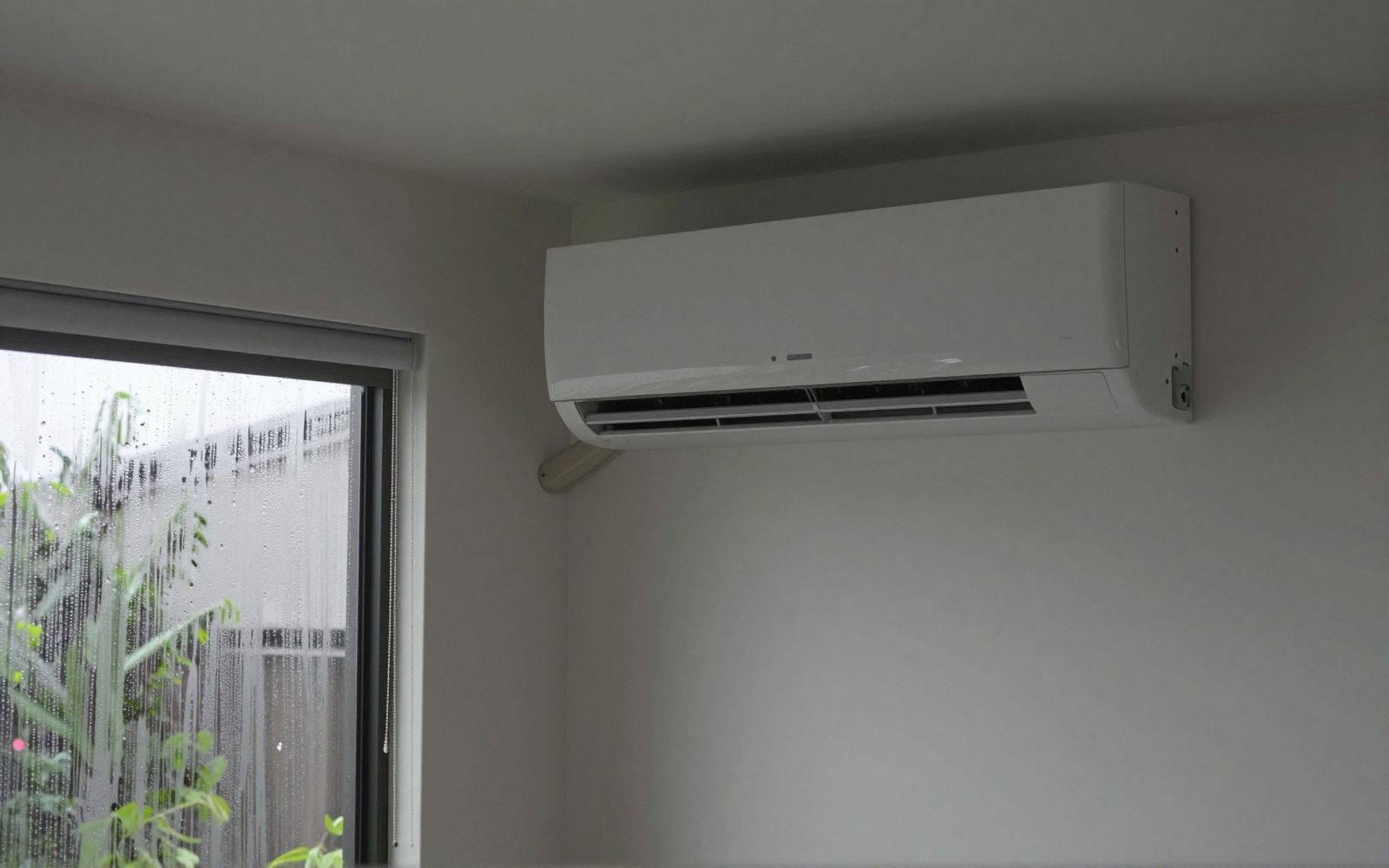
Dry mode takes moisture out of the air without trying to reach a set temperature. It is for sticky, overcast days when the air feels wet more than hot.
What it does
Mitsubishi: "Operates in Dehumidifying Mode. In this mode the unit is not trying to reach the set temperature." Daikin: it "eliminates humidity while maintaining the indoor temperature as much as possible", and controls temperature and fan speed automatically.
When to use it in Newcastle
Newcastle's afternoons are most humid from January to March: the Bureau of Meteorology's 1991 to 2020 averages for Nobbys show afternoon humidity of 74 per cent in January, 77 in February and 73 in March, against 55 in August. That late-summer stickiness, often on overcast days, is dry mode's job. On a hot clear day, cool mode does more.
Decode your remote
Tap a symbol to see what it does
A drawn, generic remote. Pick your brand for its own wording, taken from the maker's manual.
Cool
Cools the room to the set temperature.
COOL: operates in cooling mode, supplying cool air.
Cooling: the system cools the room to the temperature setpoint.
In the Hunter: Newcastle summer: 24 to 26°C is a comfortable, economical setting.
Heat
Heats the room to the set temperature.
HEAT: operates in heating mode, supplying warm air.
Heating: the system heats the room to the temperature setpoint.
In the Hunter: Hunter winter nights, especially inland around Cessnock, are when heat mode earns its keep.
Dry
Takes moisture out of the air without trying to reach a set temperature.
DRY: operates in dehumidifying mode; the unit is not trying to reach the set temperature.
Drying: decreases the humidity in a room; temperature and airflow are controlled automatically.
In the Hunter: Muggy coastal days when it is sticky but not hot: see our dry mode guide.
Fan
Moves air only. No heating or cooling.
Fan only: circulates air without heating or cooling.
Fan: the system only controls the airflow; it does NOT control the temperature.
In the Hunter: Cheapest to run; useful on mild evenings.
Auto
Chooses heating or cooling to hold the set temperature.
AUTO: the unit automatically adjusts itself to heat or cool to maintain the set temperature.
Automatic: cools or heats to the setpoint, switching between cooling and heating if necessary.
In the Hunter: Shoulder seasons when mornings are cold and afternoons warm.
Econo
An energy-saving setting. What it does differs by brand.
Econo Cool: changes the airflow to swing, creating a breeze effect so you feel cooler.
Econo: limits the maximum power consumption, useful when the unit shares a circuit with other appliances.
In the Hunter: Long cooling runs on a budget.
Powerful
Runs at maximum capacity for a short time.
High power: runs the unit harder for a short time to reach the set temperature faster.
Powerful: quickly maximises the cooling or heating effect; the unit operates at maximum capacity.
In the Hunter: Coming home to a hot house. Then turn it off.
Sensor
A motion sensor that aims the air and saves energy in an empty room.
3D i-See sensor: senses people and adjusts airflow, with an energy-saving operation when the room is empty.
Intelligent eye: detects movement and directs airflow; if no one is in the room for more than 20 minutes, it switches to energy-saving operation.
In the Hunter: Living rooms people come and go from.
Symbols vary by model: if your remote looks different, check its manual. Our drawing, not any brand's remote.
How dry mode pulls water out of the air
Every air conditioner dries the air a little when it cools. The indoor coil runs colder than the dew point, so water vapour in the room air condenses on it, drips into a tray and runs out through the drain hose. Dry mode leans on that effect. It runs the indoor fan slowly, so air spends longer passing over the cold coil and drops more of its water, and it cycles the compressor so it does not chase a low set temperature. The result is drier air with only a small fall in temperature, usually a degree or two on a mild day.
You can see it working. Within half an hour on a sticky day, water should be dripping steadily from the drain outlet outside. If nothing comes out on a humid day, the drain may be blocked, which is worth fixing before the tray overflows inside.
Dry, cool or a dehumidifier?
| Dry mode | Cool mode | Portable dehumidifier | |
|---|---|---|---|
| Main job | Remove moisture | Bring the room down to the set temperature | Remove moisture |
| Room temperature | Falls a little | Falls to the set point | Rises slightly (it gives off heat) |
| Fan | Slow, controlled by the unit | Your choice | Fixed |
| Best for | Warm, muggy, overcast days | Hot days, sunny afternoons | Cool, damp rooms, winter condensation, a room without air-con |
| Water | Drains outside through the hose | Drains outside | Collects in a tank you empty, or a hose |
A rule of thumb that works in Newcastle: if the room feels sticky but not hot, use dry; if it feels hot, use cool with a sensible set point. Our best temperature for air conditioner guide gives the settings NSW recommends.
How long to run it
Dry mode is not meant to run all day in an empty house. On a humid afternoon, an hour or two in the room you are using is usually enough to take the clamminess out. Running it overnight in a bedroom can leave the room cooler than you expect by early morning, because the unit keeps taking a little heat out while it dries. Many people find a short dry session before bed, then the timer or a gentle cool setting, more comfortable.
Keep doors and windows closed while it runs. Dry mode is drying the air in the room; with the windows open, it is trying to dry the street.
Dry mode in winter
On most split systems, dry mode is a cooling function. In winter it will make a cold room colder, so it is the wrong tool for condensation on winter windows. For that, heat the room, open a window briefly after showers and cooking, use exhaust fans, or use a portable dehumidifier, which warms the room slightly while it dries.
What it costs to run
Dry mode generally uses no more electricity than cool mode, and often less, because the compressor is not chasing a low temperature and the fan runs slowly. How much less depends on the model, the room and the day, so the simplest way to know is the running cost method in our air conditioner running cost guide: the unit's power input, the hours and your price per kWh.
When the remote says it, but nothing happens
Some units show the dry symbol but appear to stop after a few minutes. That is usually the unit doing its job: once the coil has cooled and the room is near its target, the compressor rests and the fan may slow or pause. If the room stays sticky and no water comes from the drain after half an hour, check the filter first, then book a service.
Dry mode and mould
Running dry mode on humid days helps keep moisture down indoors. A smelly unit usually needs its filter cleaned or a service: see cleaning the filter.
Common questions
Is dry mode cheaper than cool mode?
It can be, because it is not trying to cool the room to a set temperature, but it depends on the model and the day.
When should I use dry mode?
On humid days when the air feels sticky but the temperature is comfortable, common in Newcastle from January to March.
Sources
- Mitsubishi Electric NZ, MSZ-GE remote quick guide (modes, Econo Cool)
- Daikin Australia, Alira X split system operation manual (Econo, Powerful, Comfort airflow, Intelligent eye, Dry)
- Wikipedia, Newcastle, New South Wales (climate table: Bureau of Meteorology 1991-2020 normals for Nobbys)
Checked 3 October 2026. Prices are published ranges, not quotes; rebates change, so confirm with the installer and the NSW Government.